Hire an AI Consultant for Your Small Business
When you hire an AI consultant, the right one takes repetitive work off your team’s plate, like answering routine customer questions, sorting email, and keeping your listings and website current, and builds it so a person on your team still approves what goes out. You can check most of what separates a good hire from a bad one before you sign anything. This checklist comes from building and running these systems on Frog Stone Media’s own publications and tools.
What Is AI Consulting?
AI consulting is help deciding where AI fits in your business, followed by building it. An AI implementation consultant goes past advice: they connect AI to the tools you already use, test it on your real work, and hand you a system your staff can run.
For a small business, the payoff shows up in three places:
- Smoother operations. Sorting email, entering data from forms and invoices, and updating listings get handled automatically, so your team spends its time on customers. This is the core of AI automation for small business operations.
- Revenue growth. Tools that bring visitors back, content that ranks, and a website that turns more visits into calls and orders.
- Happier customers. Faster answers to common questions, accurate information on your site, and fewer requests that fall through the cracks.
An AI consultant for business starts from your workflow and picks the tool second, where a software vendor starts from its own product and looks for a place to fit it.
Signs Your Business Is Ready
You do not need a data team or a large budget. You are ready when:
- Someone does the same task by hand every day or every week, in the same steps: copying order details between systems, answering the same handful of questions, re-keying invoices.
- The information lives in places you already control, like email, a spreadsheet, a booking system, or your website.
- Someone on your team can own the result and check the output for the first few weeks.
- You can describe what a correct result looks like for that task.
If the work changes every time and depends on judgment calls nobody has written down, start by writing down how it gets done. A good consultant helps you do that before building anything.

What to Look For in an AI Consultant
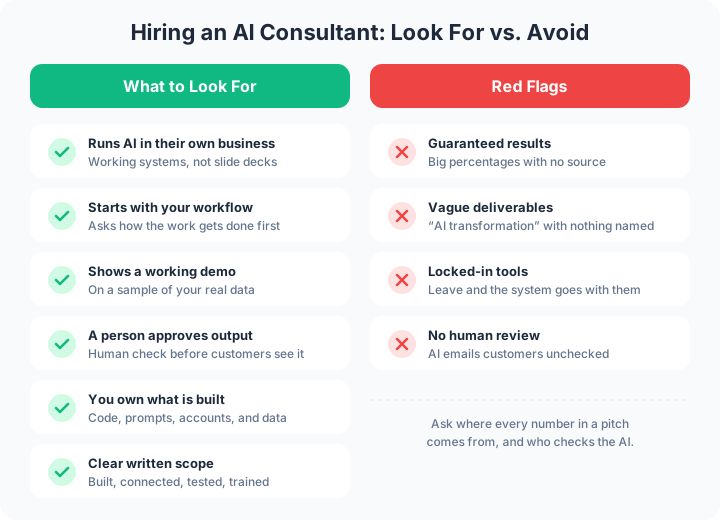
They run AI in their own business. Ask what they use AI for day to day, and look for working systems rather than slide decks. On Frog Stone Media’s own projects, The Weekly Driver has a reliability database that gives car shoppers answers they can trust. SacGroceries has price history and a planner that tells Sacramento shoppers whether one store or several gets their list cheapest.
They start with your workflow, not the tool. The first conversation should cover how the work gets done today, who touches it, and where it slows down. If the consultant names a product before asking how you work, expect the plan to be built around that product.
They show a working demo. Before you commit to a full build, you should see the system handle a sample of your real work: your emails, your forms, your product list. A demo on made-up data shows the tool runs, but not how it handles your handwritten work orders or oddly formatted supplier invoices.
A person approves the AI’s output. Anything that reaches a customer or changes a record should pass through a human check, at least until the system has proven itself on your work. On SacGroceries, AI reads store flyers and customer submissions, and a person approves the prices before anything publishes. The build process follows the same pattern: Claude Code builds, OpenAI Codex reviews the work independently, and the result is human verified and approved.
You own what’s built. Ask who owns the code, the prompts, the accounts, and the data, and look for a consultant whose clients own what is built for them, with instructions to run it if you part ways.
The scope is written down. A clear written scope says what gets built, what it connects to, what is out of scope, how you will test it together, and what training your team gets.
Questions to Ask Before You Hire an AI Consultant
- What do you run AI on in your own business? Ask to see it working.
- Which part of my work would you start with, and why that one? A good answer names one task with a clear payoff, not a whole-company overhaul.
- Can I see it work on a sample of my own data before the full build?
- Who checks the AI’s output, and how do I change what it is allowed to do?
- What happens when the AI gets something wrong? Listen for review steps and a simple way to switch a feature off.
- What do I own at the end, and can another developer pick it up?
- What training does my team get, and what does support look like after launch?
Red Flags
Promises of guaranteed results. Nobody can promise that AI will cut a fixed share of your costs or double your leads. Ask where any number in the pitch comes from. If the answer is another company’s case study, it tells you nothing about your business.
Vague deliverables. “AI transformation” and “AI strategy” are not deliverables. If you cannot tell from the proposal what will exist when the work is finished, ask until you can, or walk away.
Locked-in tools you cannot take with you. Watch for systems that only run inside the consultant’s own platform or account, with a monthly fee to keep them alive. Ask what happens to the system if you stop paying, and get the answer written into the scope.
No human review. If the plan has AI sending emails, posting content, or changing customer records with nobody checking, the first mistake reaches your customers before you see it.
How a Good Engagement Runs
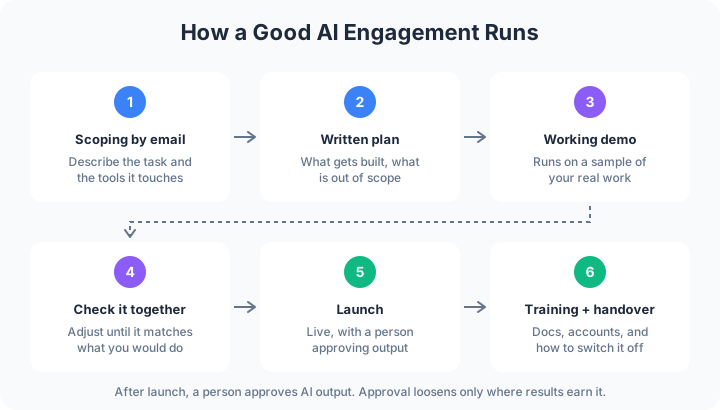
- Scoping by email. You describe the task and the tools involved in writing. A written exchange gives both sides a record of what was asked, and you answer on your own schedule instead of booking a call.
- A written plan. What gets built, what it connects to, what is out of scope, and how it gets tested.
- A working demo. The system runs on a sample of your own emails, forms, or orders, so you see it before the full build.
- Check it together. You and your staff try it the way you will use it, and the rules get adjusted until the output matches what you would have done by hand.
- Launch. It goes live with a person approving output. The approval step loosens only where the results have earned it.
- Training and handover. Your team learns how to run it, how to review it, and how to switch it off. You get the documentation and the accounts.
For Your Technical Team
If someone on your staff, or a developer you trust, will vet the consultant, hand them these questions:
- Evals and regression checks. How do they confirm the AI’s answers stay correct after a prompt, model, or data change? Look for a saved set of real test cases that gets re-run when the system changes.
- Permissions and approval gates. What can the AI read, what can it write, and which actions require a human to click approve?
- Data handling. Where does customer data go, which providers see it, and is any of it used to train models?
- Prompt-injection awareness. How do they stop text inside an email, form, or web page from giving the AI instructions?
- Model choice and cost limits. Which models handle which tasks, and what spending caps and alerts are in place?
FAQ
Should I hire an AI consultant or buy an off-the-shelf AI tool?
If an off-the-shelf tool already does the job inside software you use, start there. A consultant earns their place when the work spans several tools, depends on your own data, or needs a review step the product does not offer.
What does an AI consultant need from me to start?
A description of the task, a few real examples of the work with anything sensitive removed, a list of the tools it touches, and the name of the person who will review the output.
Have a task in mind? Email a few lines about it: how it gets done today and the tools it touches. The reply lays out an approach built around how your business works. The AI consultant services page shows what Frog Stone Media builds and how a project runs.