Best AI Tools for Small Businesses in 2026
The best AI tools for small businesses in 2026 are the ones that take a specific job off your plate: drafting the newsletter, answering the after-hours call, matching receipts to bank lines. This guide sorts them by that job, not by hype, and notes how each one charges.
For each tool, the question is the same: does it give you smoother operations, more revenue, or happier customers, and who approves its work before anything goes out?
General AI Assistants
A general AI assistant for small business is the one tool most owners start with. It drafts emails, summarizes documents, rewrites a policy in plainer words and answers questions about a spreadsheet. All four below sell business plans that keep your content out of model training by default.
- Claude (Team plan). Projects keep the files and instructions for one job in one place, so a quoting project always works from your current price sheet. Connectors link Claude to tools like your file storage and project management apps, and Claude for Microsoft 365 and Claude for Outlook work inside those apps.
- ChatGPT (Business plan). A shared place for your team to draft customer replies and work with business information, with access managed in one spot.
- Gemini in Google Workspace. If your email already runs on Gmail, this is the Google AI for small business that needs no new account. Workspace includes Gemini features that vary by plan, with Business Standard and above adding help inside Drive and Sheets and meeting notes in Meet.
- Microsoft 365 Copilot Business. Built for companies with up to 300 users on a Microsoft 365 Business plan. Copilot works inside Word, Excel, PowerPoint and Outlook, summarizes Teams meetings, and Copilot Studio builds simple agents for repeat workflows.
The benefit: smoother operations. The first draft of almost any document takes minutes, and a person edits and sends it.
Which to pick: the one that lives where your files and email already are. A Gmail shop gets the most from Gemini, a Microsoft shop from Copilot. Claude and ChatGPT work alongside either.
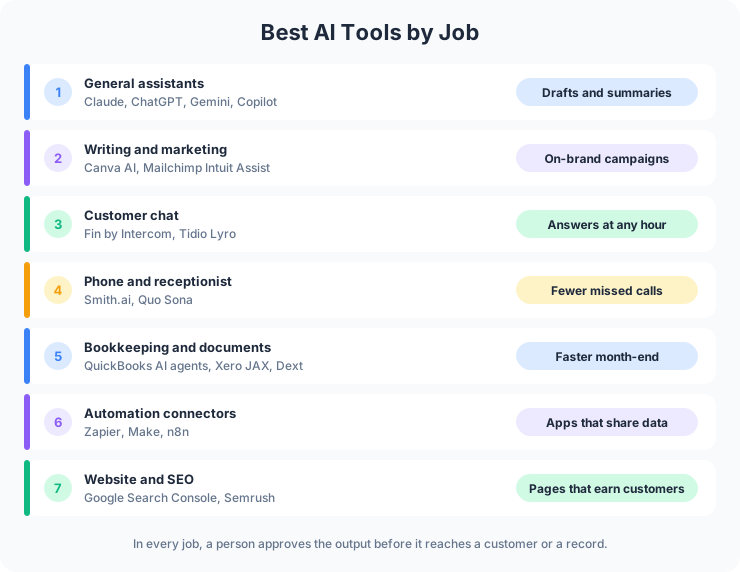
Writing and Marketing
- Canva AI. It applies your Brand Kit (your fonts and colors) to what it generates, so a sale flyer, an Instagram post and a menu insert come out matching. Magic Resize turns one design into every size you need. Brand Kit sits on paid plans.
- Mailchimp with Intuit Assist. On Standard plans and up, Write with AI drafts subject lines and email copy, and pre-built flows draft the emails for a welcome or abandoned-cart series. You review and schedule them.
The benefit: revenue growth. Campaigns go out on time instead of when someone finds a free evening, and they look like your brand every time.
Customer Service and Chat
- Fin by Intercom. An AI agent for chat, email and voice that works with Intercom, Zendesk, Salesforce, HubSpot and Freshdesk. It hands the conversation to your staff with the full history attached. Pricing is outcome-based.
- Tidio Lyro. Answers only from your own FAQ and support content, and passes anything it can’t answer to a person. Every account starts with 50 free Lyro conversations; after that, pricing is per conversation.
The benefit: happier customers. Routine questions about hours, shipping and returns get answered at 10pm. Your team approves the answer library and the handoff rules before the bot talks to anyone, and anything about money or a complaint goes to a person.
Phone and Receptionist
- Smith.ai. An AI receptionist that answers calls, qualifies leads and books appointments on the calendar you already use, with a live human receptionist available as an add-on when a call needs one.
- Quo Sona. An AI voice agent built into the Quo business phone system (formerly OpenPhone). Set it for after hours, overflow, or both. It learns from your website, PDFs and notes, speaks English, Spanish and French, and posts a summary and transcript to your team inbox. Billing is per call.
The benefit: revenue growth. A missed call from a new customer is often a lost job. You approve the script and the booking rules before it takes a single call.

Bookkeeping and Documents
- QuickBooks with Intuit AI agents. The Accounting Agent categorizes transactions, helps with reconciliation and flags odd charges, such as a phone bill far above normal. The Payments Agent tracks invoices and drafts reminders. Their work lands in a feed for you to review and approve.
- Xero JAX. Matches bank lines to invoices and bills. When it isn’t confident, it proposes a match and you decide. Keep automatic reconciliation off for any account where your bookkeeper approves each match.
- Dext. Reads receipts and supplier invoices, codes them against your QuickBooks or Xero setup, and supports a manual review before publishing, so keep auto-publish off if your bookkeeper checks each one.
The benefit: smoother operations. Month-end stops being a weekend of data entry, and your bookkeeper spends time on questions instead of typing.
Automation and Workflow Connectors
The best AI tools for small business automation in 2026 are the connectors that move information between the apps you already pay for.
- Zapier. Connects more than 9,000 apps. Zapier MCP lets Claude, ChatGPT and other assistants run Zapier actions, with app-level and action-level access controls and a history of every action.
- Make. A visual builder with thousands of app integrations, AI agents you give goals and limits, and its own MCP server. There is a free plan; paid plans run on credits.
- n8n. Run it on n8n’s cloud or on your own server. It has over 500 integrations, AI agents, and approval steps where a person signs off before a workflow continues. Cloud plans are priced by workflow runs.
The benefit: smoother operations and faster replies. A new web lead lands in your CRM, the right person gets a text, and a draft reply waits for approval.
Website and SEO
- Google Search Console. Free, and the first tool to set up. It shows which searches bring people to your site, how often you appear, and which pages get clicks, now with a filter that splits branded searches from the rest.
- Semrush. Tracks your rankings and, with its AI Visibility tools, how your brand shows up in answers from Google AI Mode and ChatGPT. It has a limited free tier and monthly plans.
The benefit: revenue growth. You see which pages earn customers and which need work, and a person decides what to change on the site.
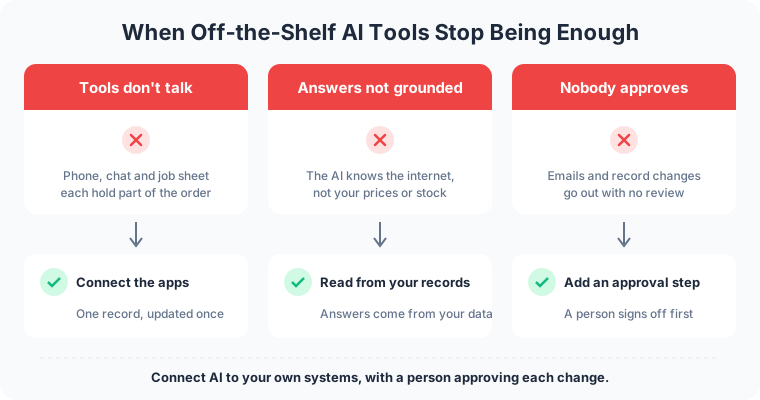
When Off-the-Shelf AI Tools Stop Being Enough
Three signs tell you a business has outgrown the tools above.
The tools don’t talk to each other. The phone agent books a job, the chat bot takes an order, and someone still retypes both into the job sheet.
Answers aren’t grounded in your own records. A general assistant knows the internet, not your price list, stock levels or service area. Pasting files into a chat window each morning is a sign the AI should read from the source directly.
Nobody approves what goes out. When an AI tool sends emails or changes records with no review step, the first mistake reaches a customer before anyone sees it.
Connecting AI to your own systems helps with all three: less retyping, answers from current records, and changes prepared for approval. AI integration services link an assistant to your booking system, inventory or website through a connection you control, with a person approving each change. On SacGroceries, a Sacramento grocery price site run by Frog Stone Media, AI reads store flyers and customer photo submissions, and a person approves every price before it publishes.
How DevSac Builds These Connections
Claude Code builds. OpenAI Codex reviews. Human verified and approved.
That is the build process, not a product recommendation. Claude Code does the planning and building, Codex reads the work independently, and a person reviews the work and how it fits your business before it goes live.
For Your Technical Team
- Data retention and training. Anthropic (Claude Team), OpenAI (ChatGPT Business), Google (Workspace) and Microsoft (Copilot Business) each state that business content is not used to train their models by default. Retention periods and custom retention vary by plan; confirm them in each vendor’s admin documentation before rollout.
- SSO and admin controls. Claude Team and ChatGPT Business include SSO. Neither includes SCIM at that tier. Workspace and Microsoft 365 manage Gemini and Copilot through their existing admin tools.
- Connectors and MCP. Claude supports custom connectors over remote MCP, which owners can restrict to read-only org-wide. ChatGPT Business supports MCP apps through developer mode, enabled by admins. Copilot Studio connects agents to MCP servers. Zapier, Make and n8n each support MCP.
- Export and ownership. Check that conversations, prompts, workflows and connector configs can be exported. Self-hosted n8n keeps workflows on your own servers. Confirm that the code, accounts and credentials for anything custom belong to your business.
Not sure which of these tools fits, or ready to connect them? Email a few lines about the job and the tools it touches, and the reply comes back with a scoped plan, no call needed. The AI consultant page shows how a project runs.