Phoenix | Cozy Idle Game for iOS and Android
Cozy tap-and-idle mobile game in development for iOS and Android, with two worlds, 20 love notes to unlock, polite ads and fair purchases, built on one shared rules contract that both native apps must match exactly.
Who it helps
Teens and young adults, 13 and up, who want a cute, low-stress game to tap at for a few minutes and come back to later. Phoenix is a cozy idle game from Frog Stone Media, in development for iPhone first and Android next. A girl named Phoenix and her dog live in a little world that fills in as the player earns hearts, and love notes arrive as envelopes to open along the way.
What players get
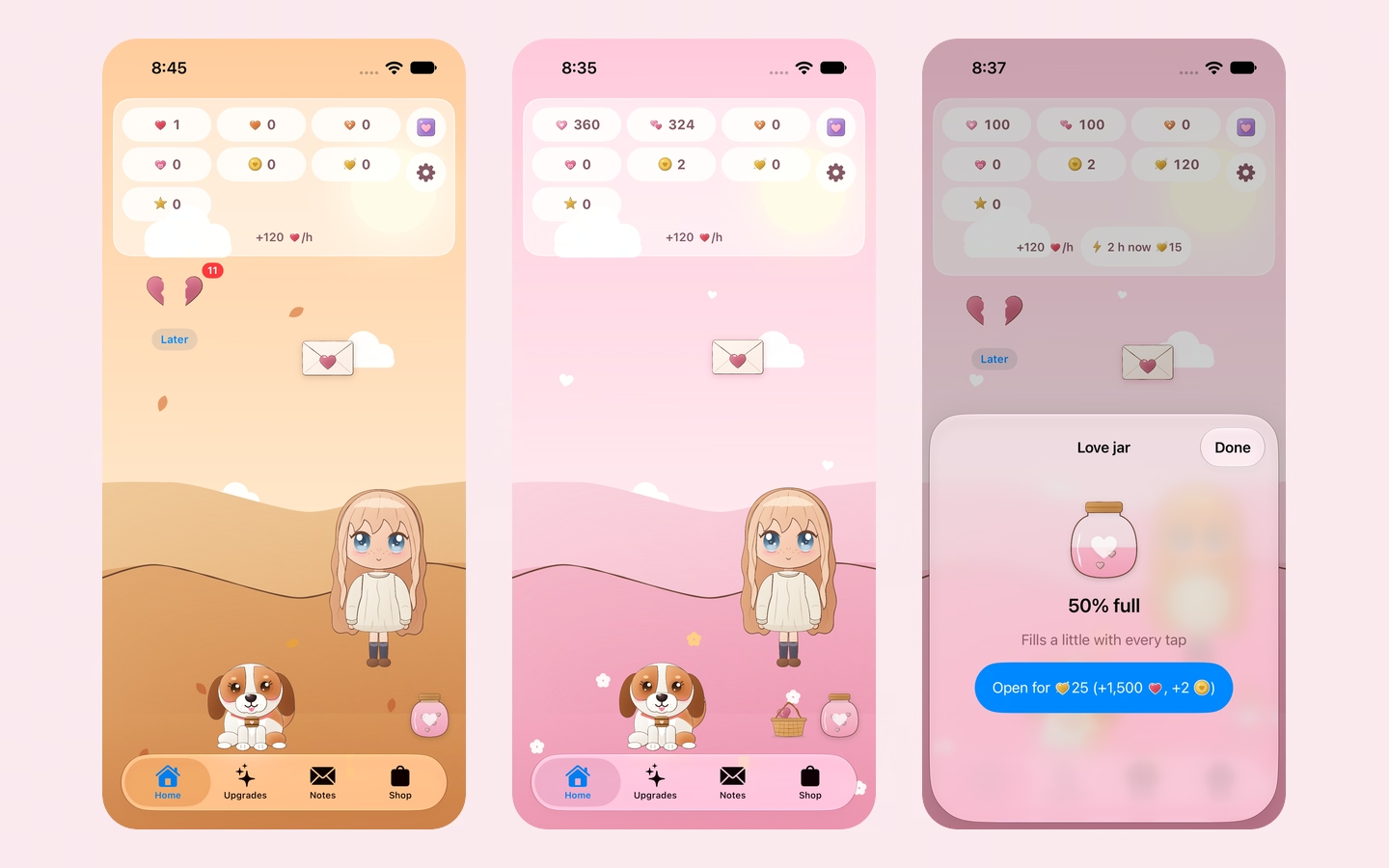
A little world that grows
The home screen is a scene: sky, hills, a house and a garden, with Phoenix and her dog in the middle. Every tap earns hearts, hearts keep coming in while the game is closed, and upgrades fill the scene and speed up specific hearts. Twenty-five outfits, accessories, jewelry and pet items change the look, and every owned item’s boost counts while worn or stored, so style stays a free choice. Two worlds ship in v1, a pink one and an autumn one, and a free player can finish both.
Cute things that happen just because
Phoenix breathes, blinks, naps and giggles when tapped, and the dog barks and dozes off. Broken hearts drift in to be mended for a surprise reward, or saved in a basket for later, shooting stars grant wishes, and a love jar fills a little with every tap. Coming back after a break brings a welcome-back gift of broken hearts to mend.
Notes, achievements and keepsakes
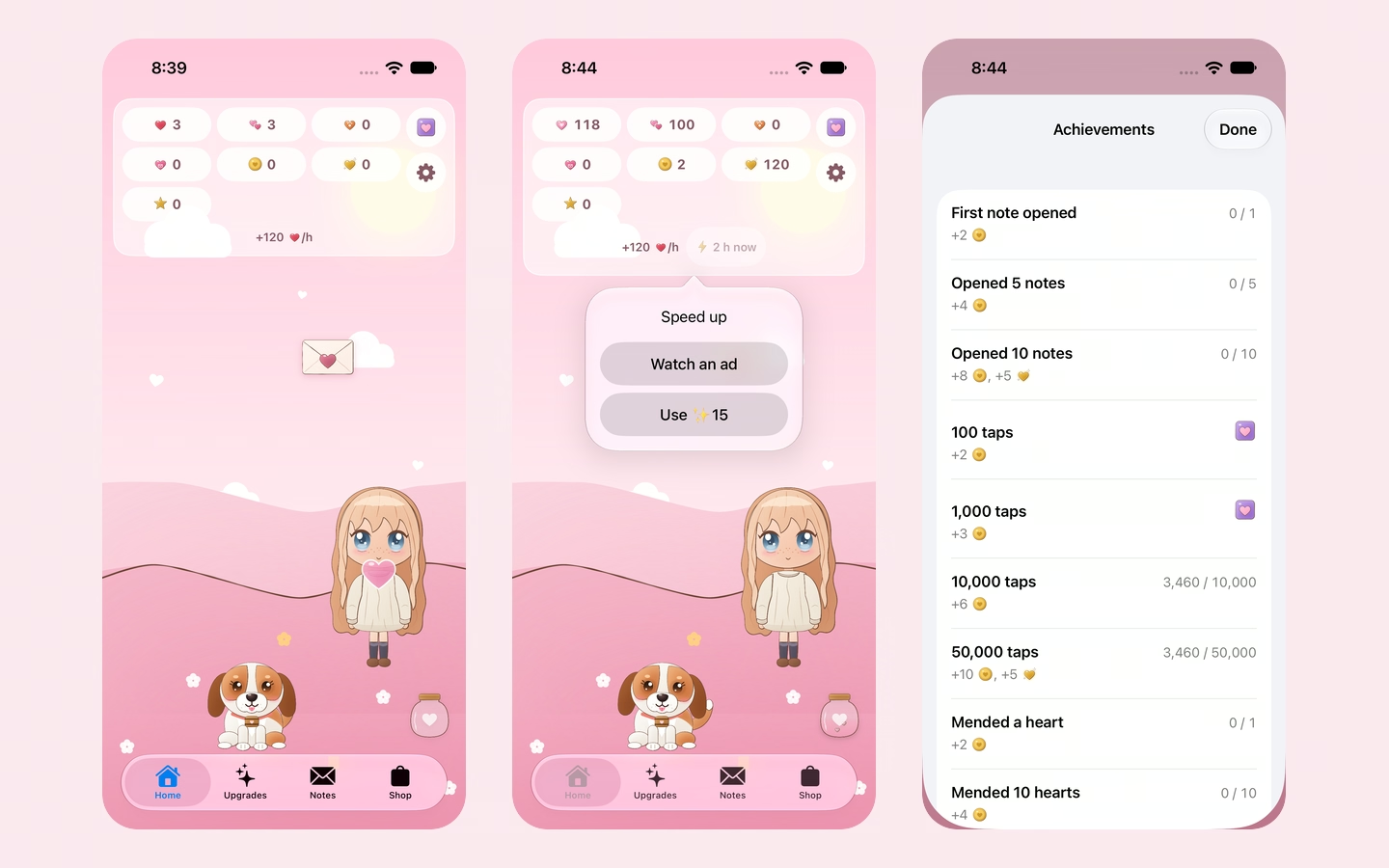
Twenty love notes unlock as the player progresses, each opening full-screen on one of four stationery designs. The player names Phoenix, the dog and themselves on first launch, and the notes use those names. Twenty achievements track taps, notes and mended hearts.
What it does for the business
The game is free to play and earns three ways: opt-in reward ads, rare interstitial ads shown only at natural breaks such as after opening a note, and purchases of Golden Love, the premium currency, plus a monthly membership that removes ads and adds a daily gift. The design keeps purchases pressure-free: tapping always earns something, so a speed-up is a shortcut. Any future paid draw has to show its odds, carry a pity guarantee and leave a free path to every item, and its rewards stay inside the game.
The same build discipline, one rules contract checked on every platform, is how an MVP grows into a product on more than one device with the versions kept in step.
How it is built
One contract, two native apps
The game’s rules live once, in a platform-neutral folder: the economy, the catalog of worlds, items and achievements, the save format and a small reference model written in standard-library Python. From that model, 87 golden test vectors and a set of conformance cases are generated by playing real actions from a new game. The Swift rules package passes every one, and the Kotlin port for Android has to pass the same files before it ships. Rules, saves and vectors use integers only, so the two apps agree to the last digit.
A balance check on every change
A validator simulates a free player on an assumed play schedule and fails if the pacing misses its targets: the pink world in 60 to 120 minutes from the start and the autumn world in 180 to 240 minutes from its unlock. Today’s run finishes them in 93 and 210 minutes.
Art and sound written as code
Phoenix, the dog, both worlds, the icons, the effects and the app icon are drawn as code with the open-source vex library, and the sounds are generated with its sister library chirp. Both are pinned to exact commits and run at build time only, so only their output ships in the app. Characters export in parts with a rig file, which is how the app animates breathing, blinking, naps and tap reactions.
Built for a young audience from the start
A neutral age prompt runs before any ad or analytics code starts. Players under 18 get non-personalized ads only, with ad tracking off, and players under 13 see a polite stop screen. Consent runs through Google’s consent form and Apple’s tracking prompt, and the under-age setting is applied to every ad request.
For your technical team
- iOS app in Swift and SwiftUI (iOS 17+), with a separate Swift rules package that passes every golden vector and conformance case.
- Android app planned in Kotlin and Jetpack Compose against the same vectors.
- Standard-library Python reference model with 139 tests; the iOS app adds 92 unit and UI tests.
- StoreKit 2 for purchases and the membership, and Google Mobile Ads with UMP consent and App Tracking Transparency.
- A versioned save file with a canonical writer, checked by the shared conformance cases.
- Art and sound generated at build time with vex and chirp, pinned to exact commits.
- Progress saves on the device, with platform-account sync in progress.
Want something like this for your business?
Send a short email about the problem you want solved and get a written scope back.
Start With a Free Email Scope