Website ROI: How to Measure the Return on Your Website Investment
“How do I know if my website is actually working?” Every business owner asks this question after their site launches. They put real money into a new website. Now they want to know if it was worth it.
The answer is a number, not a feeling. Website ROI is the ratio of what your site earns versus what it costs. Every client site gets an ROI calculation, and clients learn to track it themselves. Here is exactly how to do it.
The Website ROI Formula
The calculation is simple. The hard part is tracking the inputs accurately.

ROI = (Revenue from Website - Cost of Website) / Cost of Website x 100
A website that generates 3.33 times its first-year cost (build plus maintenance) in revenue from leads has a first-year ROI of 233%. Every dollar invested came back 3.33 times.
Most service businesses see positive ROI within 3-6 months of launch. The key is accurate tracking, which means connecting your analytics to actual revenue.
What Counts as “Revenue from Website”
For service businesses, website revenue includes every lead that came through your site and converted into a paying customer. This is not just contact form submissions. It includes:
Direct form submissions. Someone fills out your contact form. You close the deal. That revenue counts.
Phone calls from the website. A visitor sees your phone number, calls, and becomes a client. Track this with call tracking software or simply ask new clients how they found you.
Chat conversations. If you use live chat or a chatbot that captures leads, those conversions count.
Indirect attribution. A prospect reads three blog posts over two months, then calls you directly. That lead was influenced by your website even though the final conversion happened offline. Attribution modeling gets complicated here, but a reasonable approach is to credit 50% to the website.
What Counts as “Cost of Website”
Include everything you spend to build and maintain the site:
- Design and development costs. The initial build price.
- Hosting. Monthly or annual hosting fees.
- Domain name. Annual registration costs.
- Maintenance. Updates, security patches, content changes. If you have a maintenance plan, this is a fixed monthly cost.
- Content creation. Blog posts, photography, copywriting.
- SEO and marketing. If you pay for SEO services or ads that drive traffic to your site.
- Software and tools. Analytics, form builders, CRM integrations.
Do not include your time spent managing the site unless you would otherwise pay someone else to do it. Owner time is real but it distorts the calculation for comparison purposes.
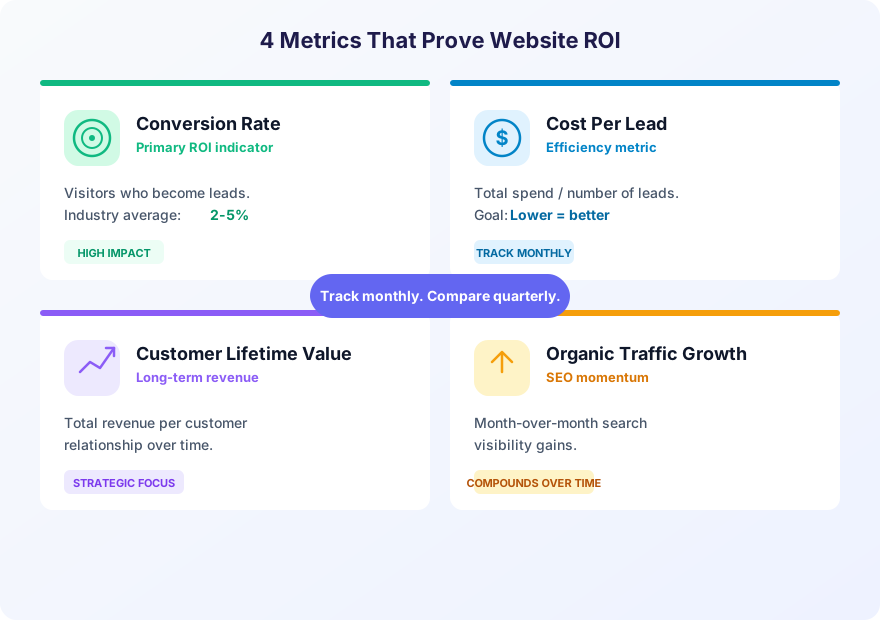
The 4 Metrics That Prove ROI
Tracking overall ROI annually is important, but monthly metrics tell you whether your investment is trending in the right direction. These four metrics are the ones worth monitoring on every client site.
Conversion Rate
Your conversion rate is the percentage of visitors who take a desired action (submit a form, make a call, start a chat). The industry average for service business websites is 2-5%.
If your conversion rate is below 2%, you have a design or messaging problem. Your traffic is arriving but not converting. Fix your homepage, add stronger CTAs, and improve your trust signals before spending money on more traffic.
If your conversion rate is above 5%, your site is performing well. Focus on increasing traffic through content and SEO to multiply the impact of that strong conversion rate.
Cost Per Lead
Divide your total website investment (build + maintenance + marketing) by the number of leads generated. The same annual investment spread across 480 leads costs a quarter as much per lead as it does across 120.
Compare this to other marketing channels. Google Ads in competitive industries run $50-200 per click (not per lead). Direct mail typically costs $100-500 per lead. A well-built website usually delivers the lowest cost per lead of any marketing channel after the first year.
Customer Lifetime Value (CLV)
A single website lead is worth more than one project if you retain the client. A web design client who becomes a monthly maintenance plan subscriber is worth twelve payments a year on top of the initial project, not just the project.
Factor CLV into your ROI calculation. Compare your cost per lead to a full year of client value, not to the first invoice.
Organic Traffic Growth
Month-over-month growth in organic search traffic is the leading indicator of future ROI. More traffic with the same conversion rate equals more leads.
Track this in GA4 under Acquisition > Traffic acquisition > Organic Search. A healthy site should show 5-15% monthly organic traffic growth in the first year after launch, stabilizing to 2-5% as the site matures.
When Does a Website Pay for Itself?
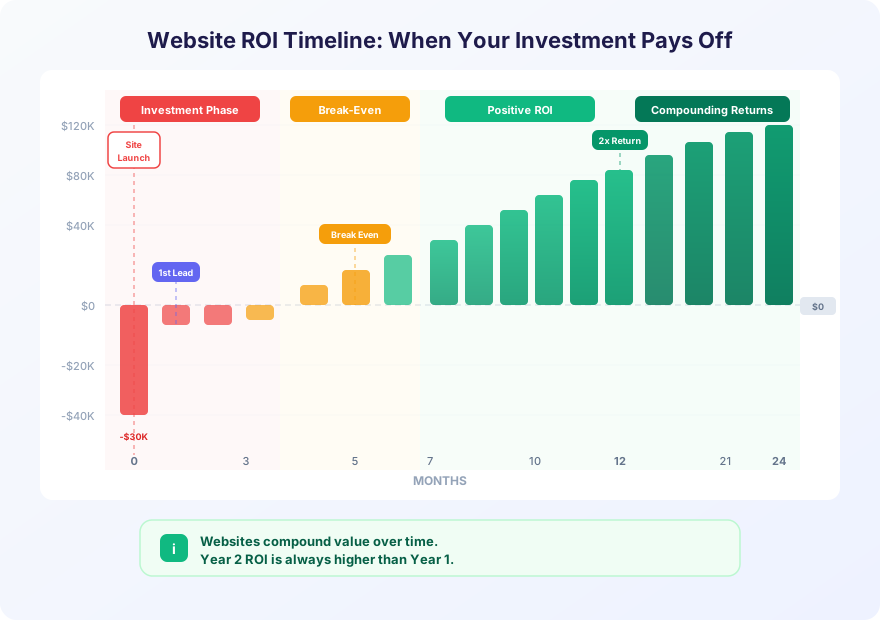
The payback timeline depends on your industry and average deal size:
High-value services (law firms, SaaS, consulting): One or two closed deals from the website covers the build cost. Break-even in 1-3 months is common.
Mid-value services (web design, marketing agencies, medical practices): 5-10 closed deals covers the build cost. Break-even in 3-6 months.
Lower-value services (restaurants, retail, local services): Break-even takes 6-12 months, but the compounding effect is significant. A restaurant website that drives 20 additional covers per week adds more than 1,000 covers a year, which pays back a modest site many times over.
The critical insight: website ROI compounds. Year 2 is always better than Year 1. Your content accumulates search rankings over time. Your domain authority grows. Your conversion rate improves as you optimize based on data. A website is not a one-time expense. It is a compounding asset.
How to Set Up ROI Tracking
You do not need expensive software. GA4 and a spreadsheet are enough.
Step 1: Set up conversion tracking in GA4. Create events for form submissions, phone clicks, and chat initiations. Mark them as conversions.
Step 2: Create a monthly spreadsheet with columns: organic traffic, total leads, conversion rate, estimated revenue from closed leads, monthly costs.
Step 3: Calculate ROI quarterly. Monthly is too noisy (one bad month skews the picture). Quarterly gives you enough data to see trends.
Step 4: Review and optimize. Low conversion rate? Improve the design. Low traffic? Invest in content. High traffic but low leads? Fix the navigation and CTAs.
FAQ
What is a good website ROI?
A 100% ROI (doubling your investment) is the minimum benchmark. Most well-built service business websites achieve 200-500% ROI within the first year. Higher-value services often see 1,000%+ ROI because a single client can cover the entire website cost.
How long does it take for a website to show ROI?
Most service business websites break even within 3-6 months. Content-driven strategies take longer (6-12 months) because SEO results compound over time. Paid advertising can accelerate the timeline but adds to the cost side of the equation.
How do you calculate ROI if your website does not sell directly?
For lead generation sites, estimate the revenue by multiplying leads by your close rate by your average deal value. If your site generates 40 leads/month, you close 20%, and your average deal is $5,000, your monthly website revenue is approximately $40,000.
Your website is either making you money or it is not. The only way to know is to track the numbers. Set up conversion tracking, calculate your cost per lead, and review ROI quarterly. If the numbers are good, invest more in content and traffic. If they are not, fix the conversion points before spending another dollar on marketing.
Want to build a site with measurable ROI? Start with your goals.