Why Node.js Is the Go-To for Web Applications
Every Frog Stone Media web application runs on Node.js. Paddle Conditions (Fastify + Drizzle ORM), SacGroceries (Cloudflare Workers + Hono), ContentMK (Electron + Express), the Amazon Creators API (serverless Node.js). The stack varies. The runtime does not.
Here is why, with real production data.
TypeScript Everywhere
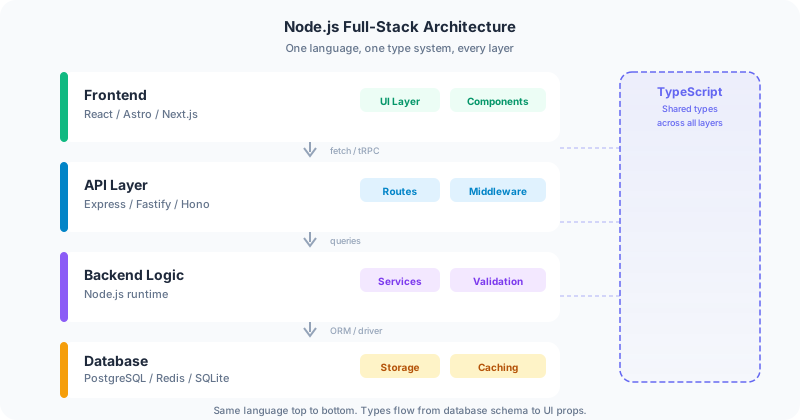
The single biggest advantage of Node.js for web applications is TypeScript across the full stack. The same language, the same type system, the same tooling on the frontend and the backend. No context switching between Python and JavaScript. No maintaining separate type definitions for your API.
For Paddle Conditions, the scoring algorithm runs on the server. The dashboard renders on the client. Both consume the same TypeScript interfaces for location data, weather conditions, and paddle scores. When a field changes in the API response, the TypeScript compiler flags every client component that needs to update. That kind of type safety across the stack boundary prevents an entire category of bugs.
This matters even more for APIs. The Amazon Creators API exposes endpoints that other applications consume. TypeScript interfaces define the contract. If the response shape changes, consumers know at compile time, not at runtime when a user reports a broken feature.
Performance Where It Matters
Node.js is not the fastest runtime. Go is faster. Rust is faster. But for web applications, Node.js is fast enough, and the development speed advantage more than compensates.
Real numbers from production:
-
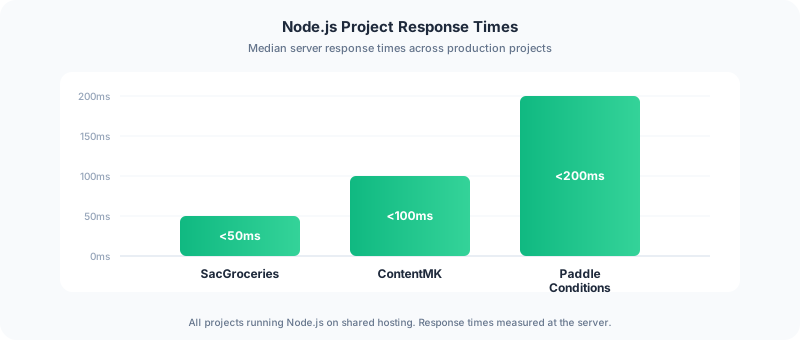
SacGroceries API: Fast responses from Cloudflare Workers. Price comparisons across stores return before the user finishes typing, because the code and data run at the edge.
-
Paddle Conditions API: Scoring calculations across 7 data sources (USGS, NOAA, NWS, and more) return in under 200ms. The scoring algorithm weighs multiple factors, adjusts for activity type, and applies hard vetoes for dangerous conditions. All computed per-request.
-
ContentMK local API: Express server handling WordPress REST API calls, SQLite queries across 13 tables, and Levenshtein distance matching across well over a thousand tags. Response times are under 100ms for everything except full-site imports.
For web applications serving real users (not benchmarks), these numbers are more than adequate. Nobody notices the difference between a 30ms response and a 3ms response. They notice the difference between a 30ms response and a 3-second response.
The Ecosystem Advantage
npm has over 2 million packages. That is not a quality statement. It is a practical one: whatever you need to build, someone has already solved part of it.
Paddle Conditions uses Stripe for subscription billing, HACS for Home Assistant integration publishing, and Drizzle ORM for type-safe database access. None of these required building from scratch. Each one saved weeks of development time.
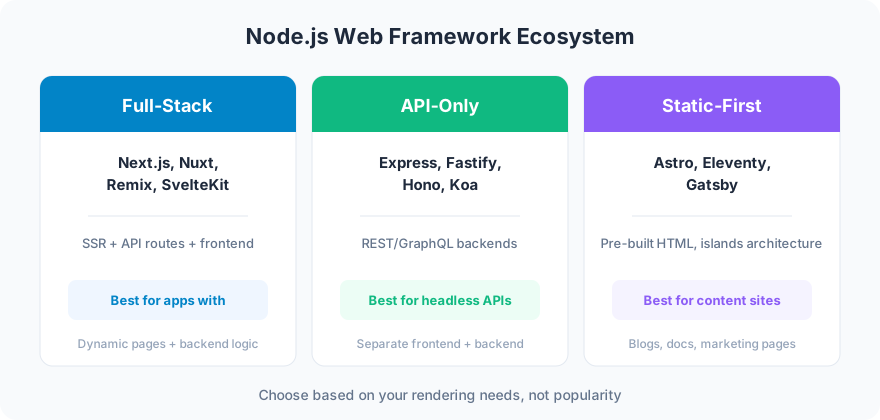
For SacGroceries, the Hono framework provided Express-like routing built specifically for edge runtimes. It handles Cloudflare Workers, Deno, and Bun without modification. The framework choice saved days of boilerplate and gave the project a routing layer that felt immediately familiar.
The ecosystem also means hiring is easier. Node.js developers are the largest pool of backend developers worldwide. If your application needs to scale beyond one developer, the talent pool matters.
When Node.js Is Not the Right Choice
CPU-intensive computation. If your application does heavy number crunching, image processing, or machine learning inference, Go, Rust, or Python are better choices. Node.js is single-threaded by default, and while worker threads exist, CPU-bound work is not what the runtime is optimized for.
Real-time systems with strict latency requirements. Game servers, trading systems, or anything where microsecond latency matters. Node.js’s event loop introduces jitter that these systems cannot tolerate.
Simple static websites. If your project is a 10-page business website with no dynamic functionality, you do not need a Node.js backend. Build it with Astro and serve static files.
For everything else, from APIs and web apps to SaaS products and data pipelines, Node.js with TypeScript is the productive choice.
The Stack
Every project is different, but the core stack stays consistent:
- Runtime: Node.js (or Cloudflare Workers for edge deployment)
- Language: TypeScript, strict mode, across frontend and backend
- API Framework: Fastify (high performance) or Hono (edge-native)
- Database: SQLite/D1 for simple apps, PostgreSQL for complex ones
- ORM: Drizzle (type-safe, no magic)
- Frontend: React (when needed) or Astro (for content-heavy sites)
- Payments: Stripe
- Hosting: Cloudflare (Workers + Pages + D1) or traditional VPS
This stack is opinionated. It has been used enough to know the trade-offs, the failure modes, and the performance characteristics. That means faster development, fewer surprises, and a production system that can be debugged at 2 AM if something breaks.
What This Means for Your Project
If you are building a web application, API, or SaaS product, the technology stack matters. Not because one language is objectively better than another, but because the developer’s experience with the stack determines how fast the project ships and how reliable the result is.
Node.js and TypeScript run across every project in the portfolio. The stack is proven, the code is maintainable, and the applications perform in production.
If you need a web application, API, or SaaS product built with Node.js, get in touch.