Using AI Pair Programming to Build Websites Faster
Pair programming used to mean two developers sitting at one keyboard. One drives, one navigates. It works, but it is expensive: two salaries producing one developer’s output, with the upside of better code quality and fewer bugs.
AI pair programming keeps the benefits and drops the cost. Frog Stone Media uses it every day across multiple codebases, and it has changed the approach to everything from feature development to debugging to code review. Here is the actual workflow.
What AI Pair Programming Looks Like in Practice
This is not “tell an AI what to build and hope for the best.” That is vibe coding, which has its place. AI pair programming is closer to working with a senior developer who has infinite patience, perfect memory of documentation, and no ego about being wrong.
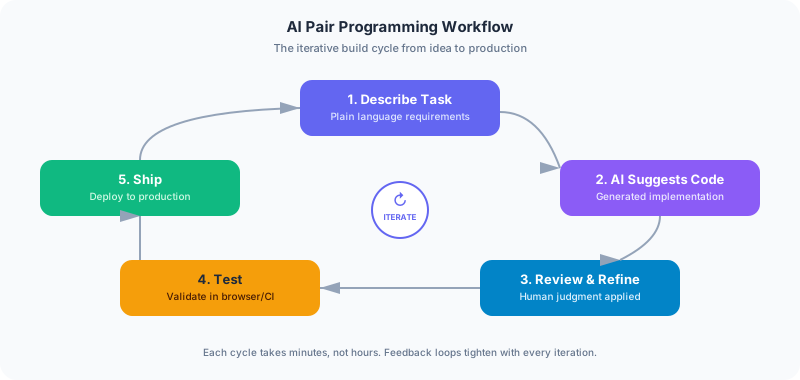
The workflow looks like this:
- The developer decides what to build or fix.
- The developer describes the problem or feature in context.
- The AI suggests an approach or writes initial code.
- The developer reviews, questions, and steers.
- Developer and AI iterate until the implementation is right.
The key difference from vibe coding is that the developer understands every line of code that ships. Generated output is not accepted on faith. The AI is there to move faster through work the developer could do alone, while catching what a human would miss.
Code Review That Never Gets Tired
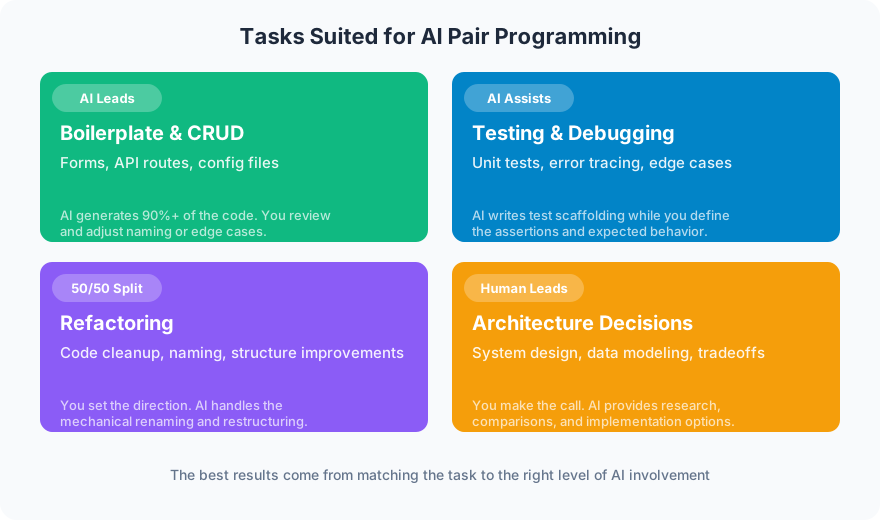
The most valuable AI pair programming use case is code review. Human reviewers get fatigued. They skim long diffs. They miss edge cases in the 47th file of a pull request. AI does not.
When 24 service pages shipped for DevSac, each page had its own Astro template, JSON-LD schema markup, frontmatter metadata, and internal linking. That is a lot of surface area for inconsistencies. AI pair programming caught issues that manual review would have missed: a missing FAQ schema on one page, an incorrect breadcrumb path on another, a frontmatter field that used a different format than the rest of the collection.
Client projects get the same approach. Before any code ships, the AI reviews it for:
- Consistency with the rest of the codebase
- Accessibility issues (missing alt text, contrast ratios, keyboard navigation)
- SEO problems (missing meta tags, broken internal links, schema errors)
- Security vulnerabilities (unsanitized inputs, exposed API keys, injection vectors)
This is not replacing human judgment. It is adding a systematic check that happens every time, on every file, without the reviewer having a bad day.
Debugging Complex Issues
Some bugs are obvious. A typo in a variable name. A missing import. These are not interesting.
The interesting bugs are the ones that involve multiple systems interacting. In one bug, dark mode on this site looked correct in development but broke in production. The cause was a CSS keyframe animation that hardcoded light-mode colors, and CSS animations override regular style rules. In dark mode, the animation’s cream backgrounds painted over the dark theme.
This is the kind of bug where AI pair programming shines. You describe the symptom (“dark mode hero section shows light colors”), provide context (“the hero has a golden-hour CSS animation”), and the AI can identify the root cause (“CSS animations have higher specificity than class-based styles, so the keyframe colors override the dark mode background”) and suggest the fix (“create a parallel dark-mode animation and apply it conditionally with html.dark”).
Without AI pair programming, this bug requires you to mentally trace the specificity cascade through animations, classes, and dark mode selectors. With it, you have a collaborator who can hold the entire CSS model in context simultaneously.
Building Features Iteratively
The traditional approach to building a feature is: plan it, spec it, build it, test it, ship it. AI pair programming compresses the feedback loop between building and testing.
On the content collection system for WHFoods.info (1,000+ pages of cross-referenced nutrition content), the data modeling required constant iteration. Foods reference nutrients. Nutrients reference foods. Recipes reference both. Meal plans reference everything. Getting those relationships right without circular dependencies or orphaned content required dozens of small decisions.
AI pair programming made it possible to try an approach, immediately check if it handled edge cases, refine, and move on. Instead of spending 30 minutes modeling a relationship mentally, the workflow was to describe the constraint, see a proposed implementation, and validate it against real data in under 5 minutes.
The same applies to smaller features. Adding a pricing table component? Describe the structure, review the generated code, tweak the styling, done. The iteration speed is what makes it valuable, not the code generation itself.
Testing and Validation
AI pair programming also handles test coverage that would be impractical to do manually. Some examples:
WCAG accessibility validation. Checking every text and background color combination on an 85-page website against contrast ratio requirements. It runs after every significant style change. The last audit checked AAA compliance (the strictest standard) across every element.
Schema markup validation. Every service page, industry page, and area page on this site has JSON-LD structured data. AI pair programming validates that every schema block is syntactically correct, references the right URLs, and follows Google’s structured data guidelines.
Internal link consistency. When a new page is added, existing content should link to it where relevant. AI pair programming scans the entire content collection for natural linking opportunities, suggests anchor text, and flags orphan pages that have no inbound links.
Content collection validation. With 30+ blog posts, 12 projects, 24 service pages, and 11 area pages, keeping frontmatter schemas consistent matters. A missing field means a broken page. AI pair programming validates every content file against the expected schema.
What Does Not Work
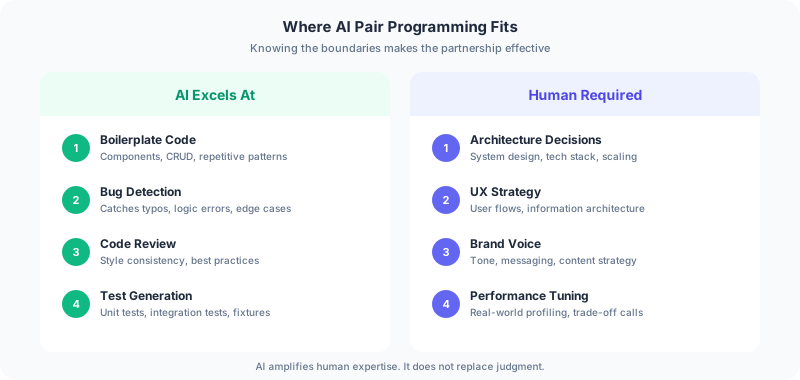
Replacing domain expertise. AI pair programming makes a developer faster at the things they already know how to do. It does not create expertise in areas where the developer lacks experience. Knowing that a law firm website needs specific disclaimer language, or that a medical practice site needs HIPAA-compliant forms, comes from building sites in those industries. The AI can implement the requirement, but it cannot identify the requirement in the first place.
Architecture from scratch. Deciding whether to use Astro or Next.js, whether to go static or server-rendered, whether the data model should be relational or document-based, these decisions require understanding trade-offs that depend on context the AI does not have. The developer makes the architectural decisions. The AI helps execute them faster.
Replacing code ownership. Every line of code that ships to production is code the developer understands and can maintain. AI pair programming that generates code the developer cannot explain is not pair programming. It is delegation to an unreliable contractor. The developer has to remain the expert.
The Bottom Line for Clients
AI pair programming means every website built this way gets more thorough testing, faster iteration, and systematic quality checks that were not economically feasible before. The same budget buys more: more accessibility testing, more SEO optimization, more cross-browser validation, more thorough code review.
If you want a developer who uses AI pair programming to deliver more thorough, more tested, and faster results, get in touch about your project.