AI Website Builders: What They Get Right and What They Miss
The pitch is hard to argue with: describe your business, pick a style, get a website in minutes. The same brief went through four AI website builders to find out how close that pitch matches reality.
The brief was simple: local service business, needs a contact form, three to four service pages, and basic local SEO. The tools: Wix AI, Hostinger AI, Durable, and 10Web. Every tool produced a working site in two to four minutes. The layouts looked professional. The copy read like it was written by a consultant who has never met a real client. Every site contained some version of “We’re dedicated to excellence” or “Committed to delivering results.”
A website that exists is not a website that works.
What AI Builders Get Right
These tools have real strengths, and ignoring them misses the point.
Speed to first draft is genuine. Two to four minutes from a blank page to a complete layout with sections, imagery, and placeholder copy is a legitimate value. A developer cannot compete with that on first-draft speed.
The layouts are professionally structured. You get hero sections, service grids, testimonial rows, and contact forms without making a single design decision. For a business owner with no design background, that removes a real obstacle.
Cost is $10 to $15 per month with hosting and domain bundled. For the first year, you spend $120 to $180 on your entire web presence. That is not nothing.
Wix specifically has a mature manual editor underneath its AI layer. Once the AI generates the initial layout, you can customize every element. The drag-and-drop experience is one of the better ones in this category.
For testing a business idea or getting a placeholder up in 48 hours, these tools deliver exactly what they promise.

Where They Fall Short
Here is where the gap between “a website” and “a website that works” becomes concrete.
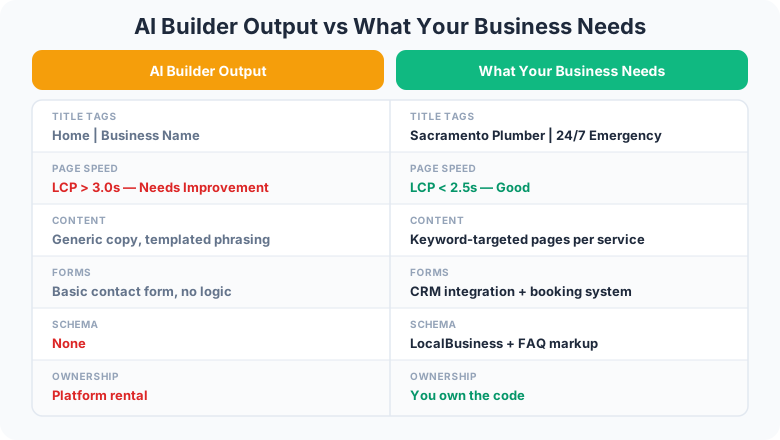
SEO structure. Every tool generated generic page titles. Durable defaulted to “Home | Business Name” on every home page. 10Web produced URLs like /page-3 for service pages. None of them added schema markup, structured title tags targeting real keywords, or any internal linking between pages. SEO is not something you layer on top of an AI-generated site without rebuilding significant pieces of it.
Performance. Core Web Vitals scores were the clearest failure. Wix AI and Durable both produced sites with LCP times above 3.0 seconds on mobile. Google’s threshold for “Good” is 2.5 seconds. Neither tool defaulted to AVIF or WebP image formats. Lazy loading was inconsistent. 10Web, which runs on WordPress, pulled in enough plugin overhead to push initial page weight past 2.5MB on a simple five-page site.
Custom functionality. Every tool produced a contact form. None of them supported conditional logic (show a field only if the user selects a specific service), CRM integrations, or appointment booking with real availability rules. If your business runs on scheduling, you are looking at a third-party tool bolted onto the side.
Content strategy. AI writes words. It does not write a keyword strategy. Every service page Hostinger AI returned used the same sentence structure and similar phrasing. Google does not reward generic copy, and none of these tools connect content to search volume, competitor gaps, or business-specific differentiation. The result looks complete until you try to rank it.
Accessibility. ADA compliance requirements are not optional for most businesses. Durable generated a form with unlabeled inputs. Wix AI produced hero text with a contrast ratio below 4.5:1 on two of the three template options tested. 10Web’s AI-generated sections included images with no alt text. In regulated industries or any business open to the public, these failures carry real legal risk.
Ownership and maintenance. You rent the platform. The code is not yours. There is no version history, no staging environment, and no way to move the site if the platform raises prices, changes terms, or shuts down. Wix has raised prices three times in four years. When that happens, you start over or pay the new rate.
When to Use an AI Builder vs Hire a Developer
This is a direct decision, not a philosophical one.
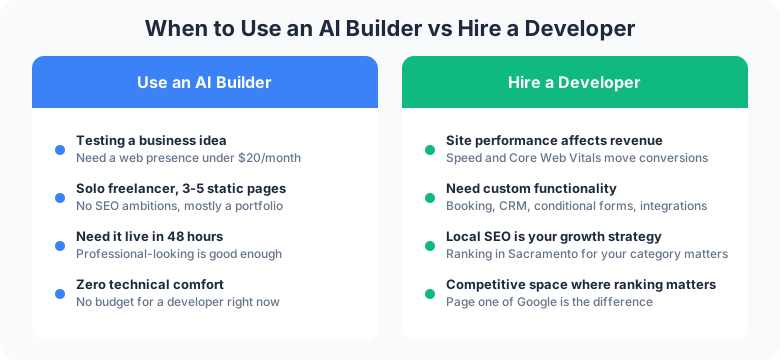
Use an AI builder when you are testing a business idea and need a web presence for under $20 a month. When you are a solo freelancer with three to five static pages and no SEO ambitions. When you need something live in 48 hours and professional-looking is good enough. When you have zero technical comfort and no budget for a developer.
Hire a developer when site performance affects revenue. When you need custom functionality that does not exist in a plugin catalog. When local SEO is your primary growth channel and ranking in Sacramento for your service category matters. When you are in a competitive space where the first page of Google is the difference between a full calendar and an empty one.
The economics shift faster than most people expect. A $15 per month builder generating zero leads costs more in opportunity than a developer who builds something that converts. A site that ranks on page one for “Sacramento HVAC contractor” pays for itself in the first booking. The full website cost breakdown gets into exactly where professional work makes sense at each budget level.
The calculation is not “builder vs developer” in the abstract. It is “what does this site need to do, and does this tool do that.”
Already have an AI-built site and not sure if it is worth fixing or rebuilding? That depends on what it is actually doing. Reach out for a free assessment by email.