Graphic Design vs Web Design: What Is the Difference?
Clients and junior designers ask this question at least once a month. Graphic design and web design share visual principles like color theory, typography, and layout, but the similarities end there. The two disciplines solve different problems with different tools under different constraints.
Medium: Static vs Interactive
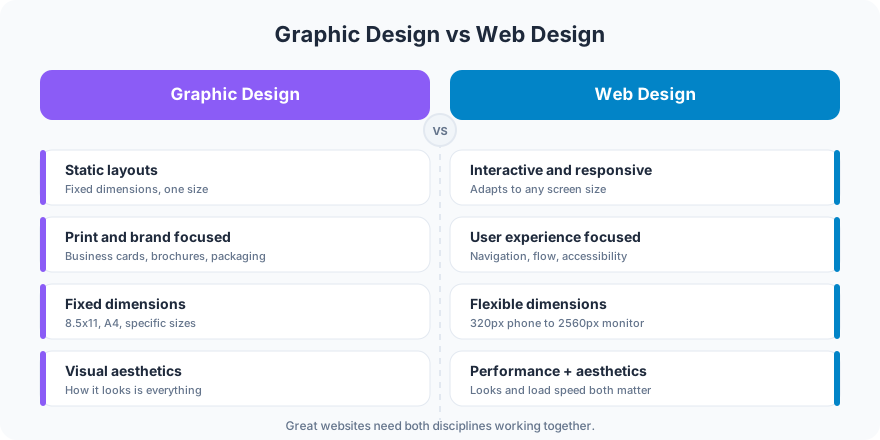
Graphic design produces static outputs. A logo, a business card, a billboard, a magazine spread. The viewer sees exactly what the designer created. Nothing moves, nothing responds, nothing changes.
Web design produces interactive experiences. A visitor clicks, scrolls, taps, hovers, and resizes. Every element on the page responds to user input. On a modern site, a single button has four visual states: default, hover, active, and focus. A print designer handles one state. A web designer handles all of them.
Dimensions: Fixed vs Fluid
A business card is 3.5 by 2 inches. A poster is 24 by 36 inches. Graphic designers work with fixed dimensions. The canvas size is known before the first pixel is placed.
Web designers work with infinite screen sizes. The same page renders on a 320px phone, a 768px tablet, a 1440px laptop, and a 2560px ultrawide monitor. Every DevSac build gets tested across at least 5 breakpoints. A layout that looks perfect at 1440px can break completely at 375px.
Focus: Aesthetics vs UX Plus Performance
Graphic design optimizes for visual impact. A great poster grabs attention, communicates a message, and looks beautiful. Performance is not a factor. A 50MB print file is fine.
Web design balances aesthetics with usability and performance. A beautiful page that loads in 8 seconds fails. A fast page with confusing navigation fails. Every client site gets Core Web Vitals tracking: Largest Contentful Paint under 2.5 seconds, Cumulative Layout Shift under 0.1, Interaction to Next Paint under 200ms. Graphic designers never think about milliseconds.
Tools and Skills
Graphic designers work in Adobe Illustrator, Photoshop, and InDesign. Their output is a file: a PDF, a PNG, an AI document.
Web designers work in Figma for design and then build with HTML, CSS, JavaScript, and frameworks like Astro or React. Writing code is a daily part of the job. A graphic designer who cannot code can create a beautiful mockup, but turning that mockup into a working, responsive, accessible, fast-loading website requires a different skill set entirely.
Where They Overlap
Both disciplines use typography, color, hierarchy, and white space. A strong visual designer can transition into web design by learning responsive layout, accessibility standards, and front-end code. Some of the best web designers started in print. For a broader look at what modern websites actually require, read the guide to website features every business needs.
FAQ
Can one person do both graphic design and web design?
Yes, and many freelancers do. Frog Stone Media handles both for clients. But the skill sets are distinct enough that specializing in one usually produces better results. If you need a logo and a website, hiring a designer who does both saves coordination time, but verify they have real experience in each area.
Do you need a graphic designer before hiring a web designer?
Not always. Many web designers, Michael included, create logos, icons, and brand assets as part of the web project. If you already have strong brand guidelines from a graphic designer, that speeds up the web design process. If you are starting from scratch, a web designer with branding experience can handle both.
Need a website built by someone who understands both visual design and technical performance? Get in touch to see how both disciplines come together in a finished site.