Traditional Search vs AI Search: What Changes for Your Website
Search is splitting into two channels. Traditional search (Google’s 10 blue links) still drives the majority of web traffic. But AI-powered search (ChatGPT, Perplexity, Google AI Overviews, Claude) is growing fast and changing how people find and evaluate businesses.
This is not a future prediction. It is happening now. Google AI Overviews appear on an increasing percentage of search results. Perplexity processes millions of queries daily. ChatGPT is used for product research, comparison shopping, and local business recommendations.
If your website is only optimized for traditional search, you are missing half the picture.
How They Work Differently

Traditional search crawls the web, indexes pages, and ranks them by relevance signals (keywords, backlinks, user behavior). The user gets a list of links and clicks through to find their answer. The website does the selling.
AI search ingests training data from the entire web, then generates a direct answer to the user’s question. The user gets the answer without clicking through. Sources are cited, but only the most authoritative and specific ones make the cut.
The marketing implication is fundamental:
- In traditional search, your goal is to rank and get clicked. Traffic comes to your site, and your content converts visitors into leads.
- In AI search, your goal is to be cited as a source. The AI does the selling by recommending your business. The visitor arrives pre-sold.
Both channels matter. AI search does not replace traditional search. It adds a new path that compresses the decision-making process.
How AI Changes the Marketing Funnel
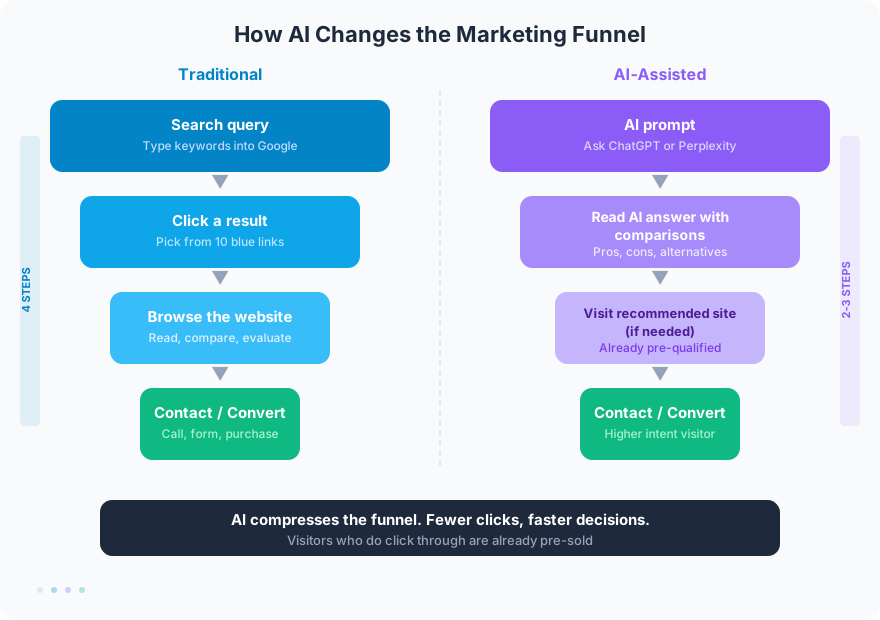
In traditional search, a prospect searches, clicks a result, browses the website, reads service pages, checks reviews, and then contacts you. That is 4-5 steps over multiple sessions.
In AI search, a prospect asks “who is the best web designer in Sacramento for law firms?” and gets a direct answer with comparisons, reviews, and recommendations. If your business is cited, the visitor arrives ready to buy. The funnel compresses from 4-5 steps to 2-3.
This means your website’s job shifts. For AI-referred visitors, the site does not need to convince them you are good (the AI already did that). It needs to confirm they are in the right place and make it easy to take action.
How to Optimize for AI Search
Traditional SEO still works. Keywords, backlinks, page speed, and structured data remain important. But AI search adds new requirements.

1. Make Your Proof Points Crawlable
AI models pull information from text, not images. Your award badges, testimonial videos, and infographic statistics are invisible to AI crawlers unless they also appear as text on the page.
Every testimonial should be in HTML text, not just a screenshot. Every award should be listed with the award name, year, and granting organization. Every statistic should appear in the body text, not locked inside an image.
2. Use Structured Data Extensively
Schema markup helps AI models understand your content. FAQ schema structures your answers for direct extraction. Organization schema identifies your business entity. Product and Service schema describes your offerings in machine-readable format.
I add JSON-LD schema to every page I build. The investment is 30 minutes per page and the payoff is visibility across both traditional and AI search results.
3. Build a Broad Digital Footprint
AI models do not just read your website. They read review sites, directories, industry publications, social media, and press mentions. A business that only exists on its own domain has a thin footprint.
Get listed in relevant directories. Earn reviews on Google, Yelp, and industry-specific platforms. Get featured in local publications. Join industry associations. Each mention is a data point that AI models can use to recommend your business.
4. Write for Decision Criteria
AI models generate comparative answers. When someone asks “best web designer for law firms,” the AI evaluates businesses against decision criteria: specialization, portfolio, pricing, reviews, location, and experience.
Your content needs to address these criteria directly. Instead of “we build great websites,” write “I have built 15 law firm websites in the past 3 years, with an average 40% increase in lead generation.” Specific, comparative, measurable claims get cited.
What Does Not Change
Despite the shift, the fundamentals remain:
Good content still wins. AI models prefer authoritative, specific, well-structured content. The same content that ranks well in traditional search gets cited in AI search.
Technical SEO still matters. Page speed, mobile responsiveness, SSL, and structured data affect both traditional rankings and AI extraction.
Backlinks still build authority. AI models use link signals (among other factors) to determine which sources are authoritative. A site with 50 quality backlinks is more likely to be cited than a site with zero.
User experience still converts. Whether a visitor comes from Google or ChatGPT, they still need to find what they are looking for and take action easily.
FAQ
Is AI search replacing Google?
No. Google still processes over 8 billion searches per day. AI search is a complementary channel that handles certain types of queries better (comparisons, recommendations, research summaries). Traditional search remains dominant for navigational and transactional queries.
Do I need to optimize for AI search separately?
Partially. Many AI search ranking factors overlap with traditional SEO (authoritative content, structured data, backlinks). The additions are: crawlable proof points, a broad digital footprint beyond your website, and content structured around decision criteria rather than just keywords.
How do I know if AI is sending traffic to my site?
Check your GA4 referral traffic for sources like chat.openai.com, perplexity.ai, and claude.ai. Also monitor “direct” traffic increases, as some AI referrals do not pass referrer data. Google AI Overviews traffic appears under organic search but with different click patterns.
The search landscape is expanding, not replacing. Businesses that optimize for both traditional search and AI search will capture traffic from both channels. The investment is incremental, not a complete strategy overhaul.
Want to make sure your site is visible in both search channels? Let’s audit your AI search readiness.